"More addictive than a goddam video game" - Balloon Juice

"One of my very favorite music blogs ever..." - Singer/Songwriter Emma Wallace

"Fascinating... really GREAT!!! You'll learn things about those tunes we all LOVE to play and blow on... SOD is required reading for my advanced students. It's fun, too!" - Nick Mondello of
AllAboutJazz.com

"I never let a day go by without checking it." - Bob Madison of Dinoship.com

"I had dinner the other night with some former WNEW staff members who spoke very highly of your work." - Joe Fay

Wednesday, July 18, 2012

Hit That Jive, Jack

By John Alston & Skeets Tolbert
1940

A red-hot little jazz number of the 1940s that continues to live on with hepcats everywhere to this day. Tolbert introduced it with his relatively obscure jazz ensemble, but it was with the Nat Cole Trio the following year that it got sent into the stratosphere. In recent years, it has become a very popular number with throwback hot jazz acts.

Happy 8th Birthday to my son--Hit that jive, Jack!

Lyrics:

Hit that jive Jack 
Put it in your pocket till I get back  
Going downtown to see a man  
And I ain't got time to shake your hand
 
Hit that jive Jack  

Put it in your pocket till I get back  
Time and time waits for no man  
And I ain't got time to shake your hand
 
Standing on a corner  

All full of jive  
But you know that you're my boy  
So I'm forced to give you five
 
Hit that jive Jack  

Put it in your pocket till I get back  
Going downtown to see a man  
And I ain't got time to shake your hand

Recorded By:

Nat King Cole
Diana Krall
John Pizzarelli
Joe Carroll
Boyd Bennett

Monday, July 16, 2012

Till There Was You

By Meredith Wilson
1957

Written for the Broadway musical The Music Man, this catchy and melodic tune was sung on stage by Barbara Cook. However, it would actually be introduced on record one month prior to the show's December 1957 opening, when Nelson Riddle's orchestra recorded it with singer Sue Raney. Peggy Lee made the song a hit in the UK in 1961, leading to a bunch of kids known as The Beatles adding it to their early repertoire. It would appear on the Fab Four's 1962 album With the Beatles, and remains the only standard the group ever recorded.

Lyrics:

There were bells on the hill

But I never heard them ringing,
No, I never heard them at all
Till there was you.

There were birds in the sky
But I never saw them winging
No, I never saw them at all
Till there was you.

And there was music,
And there were wonderful roses,
They tell me,
In sweet fragrant meadows of dawn, and dew.

There was love all around
But I never heard it singing
No, I never heard it at all
Till there was you!

Recorded By:

Shirley Jones
Anita Bryant
Sonny Rollins
Sergio Franchi
Fran Warren

Tuesday, July 10, 2012

Mary Is a Grand Old Name

By George M. Cohan
1906

Cohan--by far the most dominant figure in American songwriting just prior to the dawn of the golden era of the Great American Songbook--composed this sweet, lyrical song for his famous musical Forty-Five Minutes from Broadway, in which it was introduced by the preeminent starlet of the stage, Faye Templeton. Some have speculated that he wrote it for his second wife, whose middle name was Mary. However, it's worth noting that at the time he wrote it, he was still one year away from divorcing his first wife... Cohan had a daughter in 1909, and named her Mary.

Lyrics:

For it is Mary; Mary

Plain as any name can be
But with propriety, society
Will say, "Marie"

But it was Mary; Mary
Long before the fashions came
And there is something there
That sounds so square
It's a grand old name.

Recorded By:

George M. Cohan
Bing Crosby
James Cagney
Glen Daly
Allen Dale

Wednesday, July 4, 2012

America the Beautiful

By Samuel A. Ward & Katharine Lee Bates
1910

An extremely popular song of American patriotism--so much so that it has often been suggested as a replacement for the more cumbersome "Star-Spangled Banner" as the national anthem of the U.S.A. It began life as a poem called "Pike's Peak", written by Bates and published on July 4, 1895 in the periodical The Congregationalist (it was published under the title "America"). The poem became quite popular, and in 1910 was combined with a melody written by church organist Ward--written in 1882 and published in 1892 as "Materna", part of the hymn "O Mother Dear, Jerusalem". It was introduced on record in 1910 by Louise Homer, and by far the most popular and inspirational version of modern times would have to be the amazing rendition of Ray Charles.

With words specifically written to commemorate the Fourth of July, this is the perfect tune for enjoying this blessed holiday. Happy Independence Day from Standard of the Day!

Lyrics:
O beautiful for spacious skies,
For amber waves of grain,
For purple mountain majesties
Above the fruited plain!
America! America!
God shed His grace on thee,
And crown thy good with brotherhood
From sea to shining sea!
O beautiful for pilgrim feet
Whose stern impassion'd stress
A thoroughfare for freedom beat
Across the wilderness
America! America!
God mend thine ev'ry flaw,
Confirm thy soul in self-control,
Thy liberty in law.
O beautiful for heroes prov'd
In liberating strife,
Who more than self their country lov'd,
And mercy more than life.
America! America!
May God thy gold refine
Till all success be nobleness,
And ev'ry gain divine.
O beautiful for patriot dream
That sees beyond the years
Thine alabaster cities gleam
Undimmed by human tears.
America! America!
God shed His grace on thee,
And crown thy good with brotherhood
From sea to shining sea.
Recorded By:

Ray Charles
Elvis Presley
Whitney Houston
Barbra Streisand
Mormon Tabernacle Choir

Wednesday, June 27, 2012

Don't Cry Joe

By Joe Marsala
1949

A breakout hit of the postwar years, written by jazz clarinest Marsala and introduced by popular 1940s and '50s crooner Johnny Desmond (pictured). Some believed at the time that the song's lyrics indicated trouble with Marsala's marriage--but actually the songwriter claimed it was meant for GIs returning after serving in World War II to discover their sweethearts had taken up with other men.

Lyrics:

Don't cry, Joe, let her go, let her go, let her go,
Don't cry, Joe, let her go, let her go, let her go.

You got to realize this is the wind-up,
You're gonna feel much better once you made your mind up.
Don't cry, Joe, let her go, let her go, let her go.

So you lost your gal, it's happened many times before,
So you sit and mope like a dope, what's that good for,
Get a hold of yourself, forget her, you lived long before you met her.
There're lots of other girls, so I say,
Don't cry, Joe, let her go, let her go, let her go.

You got to realize this is the wind-up,
You'll feel much better once you made your mind up.
Don't cry, Joe, let her go, let her go, let her go.

Take a look around and see just what you're missing,
You'll soon forget your troubles, Joe, if you'd only listen.
So don't cry, Joe, let her go, let her go, Joe, let her go.

Recorded By:

Johnny Desmond
Frank Sinatra
Godron Jenkins
Joni James

Thursday, June 14, 2012

The Curse of an Aching Heart

By Henry Fink & Al Piantadosi
1913

A dusty old chestnut from the pre-World War I era, this is a melancholy, sentimental tear-jerker of the variety that was popular at the time. It was introduced by superstar opera singer Will Oakland, and later became a standard cliche of the woeful love song. This can be seen in its hilarious inclusion in the 1930 Laurel & Hardy short Blotto. It was also resurrected as a swingin' tune by Frank Sinatra for his 1961 album, Sinatra Swings.

Lyrics:

You made me think you cared for me

And I believed in you
You told me things you never meant
And made me think them true

I gambled in the game of life
I played my heart and lost
I'm now a wreck upon life's sea
Alone I pay the cost

You made me what I am today
I hope you're satisfied
You dragged and dragged me down until
The soul within me died

You shattered each and ev'ry dream
Fooled me right from the start
And though you're not true, may God bless you
That's the curse of an aching heart.

Recorded By:

Frank Sinatra
Fats Waller
Monty Sunshine
Manuel Romain
Jimmie Davis

Tuesday, April 24, 2012

Try a Little Tenderness

By Jimmy Campbell, Reg Connelly & Harry M. Woods
1932

A song that has truly spanned generations. Introduced as a sweet love ballad by the Ray Noble orchestra in 1932, it became best known to later audiences due to the blockbuster 1966 single from Otis Redding that literally reinvented the tune as an R&B number. This version would famously be used in the 1980s film Pretty in Pink, and was recently sampled by Kanye West and Jay-Z for their 2011 record, "Otis". Talk about a song transcending the ages!

Lyrics:

She may be weary,
Women do get weary,
Wearing that same shabby dress.
But when she's weary,
Try a little tenderness.

You know she's waiting,
Just anticipating,
Things that she'll never possess.
But while she's waiting,
Try just a little tenderness.

It might be sentimental,
But she has her greaves and cares,
And soft words spoken gently
Makes it easier to bear.

She won't regret it,
Women don't forget it.
Love is their whole happiness.
But it's all so easy,
Try a little tenderness.

Recorded By:

Bing Crosby
Ruth Etting
Michael Buble
Three Dog Night
Ella Fitzgerald


Thursday, April 12, 2012

What Are You Doing the Rest of Your Life?

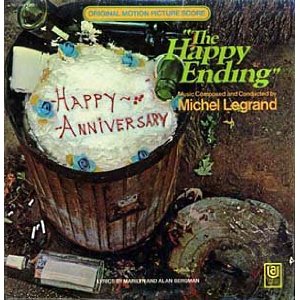
By Michel Legrand, Alan Bergman & Marilyn Bergman
1969

Legrand was one of the most prominent pop composers of the late 1960s and 1970s, and this was one of his finest. Written for the 1969 film, The Happy Ending, it was introduced by Michael Dees. It was also nominated for the Oscar for Best Song that year, but lost out to Burt Bacharach and Hal David's "Raindrops Keep Fallin' on My Head". This was one of the last of the great Best Song nominees in the classic songbook tradition. It also happened to be my parents' wedding song...

Lyrics:

What are you doing the rest of your life?
North and south and east and west of your life
I have only one request of your life
That you spend it all with me

All the seasons and the times of your days
All the nickels and the dimes of your days
Let the reasons and rhymes of your days
All begin and end with me

I want to see your face
In every kind of light
In fields of dawn
And forests of the night
And when you stand before the candles on a cake
Oh, let me be the one to hear the silent wish you make

Those tomorrow's waiting deep in your eyes
And the world of love you keep in your eyes
I'll awaken what's asleep in your eyes
It may take a kiss or two

Through all of my life
Summer, winter, spring and fall of my life
All I ever will recall of my life
Is all of my life with you.

Recorded By:

Frank Sinatra
Barbra Streisand
Sarah Vaughan
Chris Botti & Sting
Dusty Springfield

Monday, April 9, 2012

Tiptoe Through the Tulips

By Joe Burke & Al Dubin
1929

If you think it was Tiny Tim who introduced this song, then think again. This was a tried-and-true standard introduced by "The Crooning Troubadour" Nick Lucas in the movie Gold Diggers of Broadway. Lucas' version also hit number one on the pop charts and stayed for the 10 weeks. It became one of the most popular tunes of the early '30s, recorded many times. Novelty act Tiny Tim (as well as The Human Society) reintroduced it as an odd relic in the late 1960s. Tim's recording was also recently included to spooky effect in the 2011 horror film Insidious.

Lyrics:

Tiptoe through the window
By the window, that is where I'll be
Come tiptoe through the tulips with me

Oh, tiptoe from the garden
By the garden of the willow tree
And tiptoe through the tulips with me

Knee deep in flowers we'll stray
We'll keep the showers away
And if I kiss you in the garden, in the moonlight
Will you pardon me?
And tiptoe through the tulips with me

Recorded By:

Tiny Tim
The Human Society
Jean Goldkette
Johnny Marvin
Roy Fox

Wednesday, April 4, 2012

What Will I Tell My Heart?

By Jack Lawrence, Peter Tinturin & Irving Gordon

1938


A song draped in controversy! Lawrence (pictured) wrote the lyric based on a title suggested by his partner Tinturin. What Tinturin didn't mention was that he had gotten the title originally from Gordon. So when the song became a huge hit, Gordon sued through ASCAP and got part credit for the song. Due to Lawrence's connections at Decca Records, the song was introduced by Andy Kirk and His Clouds of Joy before they even had a publisher signed up.

Lyrics:

I'll try to explain to friends, dear,
The reason we two are apart;
I know what to tell our friends, dear
But what will I Tell My Heart

It's easy to say to strangers,
That we played a game from the start,
It's easy to lie, to strangers,
But what will I tell my heart

When I smile to hide all the tears inside,
what an ache it will bring;
Then I'll wander home to a telephone
that forgot how to ring

I could say you'll soon be back dear
To fool the whole town may be smart
I'll tell them you'll soon be back dear
But what will I tell my heart?

Recorded By:

Ella Fitzgerald
Fats Domino
Vanessa Williams
Joe Williams
Bing Crosby

Wednesday, March 28, 2012

Cocktails for Two

By Arthur Johnston & Sam Coslow
1934

A mellow classic from the Big Band era, this jazzy tune was introduced in the 1934 film Murder at the Vanities, in which it was sung by Carl Brisson. It would soon after become on of the Duke Ellington band's most recognizable numbers. It's lyric is a celebration of the repeal of Prohibition which occured the previous year.

Lyrics:

In some secluded rendezvous
That overlooks the avenue
With someone sharing a delightful chat
Of this and that
And cocktails for two

As we enjoy a cigarette
To some exquisite chansonnette
Two hands are sure to slyly meet beneath
A serviette
With cocktails for two

My head may go reeling
But my heart will be obedient
With intoxicating kisses
For the principal ingredient

Most any afternoon at five
We'll be so glad we're both alive
Then maybe fortune will complete her plan
That all began
With cocktails for two

Recorded By:

Duke Ellington
Spike Jones
Tommy Dorsey
Bing Crosby
Billy May

Saturday, March 10, 2012

Harlem Nocturne

By Earle Hagen & Dick Rogers
1939

One of the most recognizable standard jazz instrumentals of all time, this unique song instantly evokes just what it was meant to: The sordid side of New York City during the 1930s...yet it's still tinged with the beauty that paradoxically characterizes that city. Written originally as a tribute to saxophonist Johnny Hodges, t was introduced the Randy Brooks band in 1940, and became their theme song. Although an instrumental first and foremost, it has been recorded with vocals several times as well. It was used as the theme song to the 1980s TV series Mickey Spillane's Mike Hammer.

Recorded By:

Mel Torme
David Sanborn
The Viscounts
Duke Ellington
Harry James

Friday, February 24, 2012

Moonglow

By Will Hudson, Irving Mills & Eddie DeLange
1933

An early '30s Tin Pan Alley chestnut that soon became a popular jazz standard after being introduced by Joe Venuti and his orchestra. It has the kind of structure and chord progression that just latches on to you and doesn't let go, whether played mellow--as it usually is--or even upbeat. It was featured prominently in the Scorsese film The Aviator, and I've always wondered why Sinatra never included it on his Moonlight Sinatra album...

Lyrics:

It must have been moonglow, way up in the blue
It must have been moonglow that led me straight to you
I still hear you sayin', "Dear one, hold me fast"
And I keep on prayin', "Oh Lord, please let this last"

We seemed to float right through the air
Heavenly songs seemed to come from everywhere

And now when there's moonglow, way up in the blue
I'll always remember, that moonglow gave me you

Recorded By:

Benny Goodman
Tony Bennett & k.d. lang
Artie Shaw
Ethel Waters
Louis Prima

Sunday, February 5, 2012

Take Me Out to the Ball Game

By Jack Norworth & Albert Von Tilzer
1908

For this Superbowl Sunday, I give you the unofficial anthem of America's true pastime and greatest sport. Norworth was inspired to write the song by a sign on the subway advertising New York Giants baseball at the Polo Grounds. Von Tilzer would later add lyrics, and the song became a hit on the vaudeville circuit, introduced by Norworth's then-wife Nora Bayes. Interestingly, it would not be played at an actual major league baseball game until the mid 1930s--ironically, right around the time that Norworth and Von Tilzer actually saw their first live game.

Lyrics:

Katie Casey was baseball mad,
Had the fever and had it bad.
Just to root for the home town crew,
Ev'ry sou
Katie blew.
On a Saturday her young beau
Called to see if she'd like to go
To see a show, but Miss Kate said "No,
I'll tell you what you can do:"

Take me out to the ball game,
Take me out with the crowd;
Buy me some peanuts and Cracker Jack,
I don't care if I never get back.
Let me root, root, root for the home team,
If they don't win, it's a shame.
For it's one, two, three strikes, you're out,
At the old ball game.

Recorded By:

Frank Sinatra & Gene Kelly
Bob Dylan
Neil Sedaka & Jerry Lee Lewis
Dr. John
Esther Williams

Listen to The Jonathan Station