By Irving Berlin
1942
One of 12 original songs written by Berlin for the movie musical Holiday Inn, starring Fred Astaire and Bing Crosby (this is the movie that introduced "White Christmas". With songs written each with a holiday theme, this one is themed for Valentine's Day, and is introduced in the film by Crosby. Constructed as a waltz, the song nevertheless proved quite popular as a pop and even jazz standard.
Lyrics:
Sweetheart of mine, I've sent you a Valentine
Sweetheart of mine, it's more than a Valentine
Be careful, it's my heart
It's not my watch you're holding, it's my heart
It's not the note I sent you
That you quickly burned
It's not the book I lent you
That you never returned
Remember, it's my heart
The heart with which so willingly I part
It's yours to take, to keep or break
But please, before you start
Be careful, it's my heart
Recorded By:
Frank Sinatra
Tommy Dorsey
Bing Crosby
John Pizzarelli & The George Shearing Quintet
Vera Lynn
"More addictive than a goddam video game" - Balloon Juice
"One of my very favorite music blogs ever..." - Singer/Songwriter Emma Wallace
"Fascinating... really GREAT!!! You'll learn things about those tunes we all LOVE to play and blow on... SOD is required reading for my advanced students. It's fun, too!" - Nick Mondello of AllAboutJazz.com
"I never let a day go by without checking it." - Bob Madison of Dinoship.com
"I had dinner the other night with some former WNEW staff members who spoke very highly of your work." - Joe Fay
"One of my very favorite music blogs ever..." - Singer/Songwriter Emma Wallace
"Fascinating... really GREAT!!! You'll learn things about those tunes we all LOVE to play and blow on... SOD is required reading for my advanced students. It's fun, too!" - Nick Mondello of AllAboutJazz.com
"I never let a day go by without checking it." - Bob Madison of Dinoship.com
"I had dinner the other night with some former WNEW staff members who spoke very highly of your work." - Joe Fay
Monday, May 20, 2013
Friday, May 17, 2013
Yes Sir, That's My Baby
By Walter Donaldson & Gus Kahn
1925
An infectious tune that originated in the Roaring '20s, legend has it that the song was inspired by a visit composers Donaldson and Kahn made to the home of the immensely popular entertainer Eddie Cantor. When Cantor's daughter introduced her favorite wind-up toy, which produced a beguiling two-note melody, this led the two men to write the song based around those two notes. It was an instant hit, introduced by Ace Brigode, and has remained beloved ever since.
Lyrics:
Yes sir, that's my baby
No sir, I don't mean maybe
Yes sir, that's my baby now
Yes, ma'm, we've decided
No ma'm, we won't hide it
Yes, ma'm, you're invited now
By the way, by the way
When we meet the preacher I'll say
Yes sir, that's my baby
No sir, I don't mean maybe
Yes sir, that's my baby now
Recorded By:
Frank Sinatra
Ricky Nelson
Eddie Cantor
Lee Morse
Gene Austin
1925
An infectious tune that originated in the Roaring '20s, legend has it that the song was inspired by a visit composers Donaldson and Kahn made to the home of the immensely popular entertainer Eddie Cantor. When Cantor's daughter introduced her favorite wind-up toy, which produced a beguiling two-note melody, this led the two men to write the song based around those two notes. It was an instant hit, introduced by Ace Brigode, and has remained beloved ever since.
Lyrics:
Yes sir, that's my baby
No sir, I don't mean maybe
Yes sir, that's my baby now
Yes, ma'm, we've decided
No ma'm, we won't hide it
Yes, ma'm, you're invited now
By the way, by the way
When we meet the preacher I'll say
Yes sir, that's my baby
No sir, I don't mean maybe
Yes sir, that's my baby now
Recorded By:
Frank Sinatra
Ricky Nelson
Eddie Cantor
Lee Morse
Gene Austin
Wednesday, May 1, 2013
P.S. I Love You
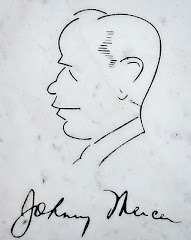
By Gordon Jenkins & Johnny Mercer1934
No, this is not the Beatles song. Years before the Fab Four were ever born, superb arranger/composer (and future Sinatra collaborator)
Jenkins and ingenious lyricist Mercer would team up to produce this utterly charming song about domestic bliss communicated over long distance. With a lyric that comprises a communication made to a significant other who is away from home, the number has a witty, quaint appeal that's easy to understand. It was introduced by none other than Rudy Vallee, but later enjoyed revivals in the 1940s, '50s and '60s. Most recently, the Bobby Vinton version was featured in an episode of Mad Men.
Lyrics:
Dear, I thought I'd drop a line
The weather's cool, the folks are fine
I'm in bed each night at nine
P.S. I love you.
Yesterday we had some rain
But all in all, I can't complain
Was it dusty on the train?
P.S. I love you.
Write to the Browns just as soon as you're able
They came around to call
And I burned a hole in the dining room table
Now let me think, I guess that's all
Nothing else for me to say
And so I'll close, but by the way
Everybody's thinking of you
P.S. I love you.
Recorded By:
Billie Holiday
Frank Sinatra
Bing Crosby
The Vogues
Nancy LaMott
Monday, March 25, 2013
A Lifelong Pursuit of Beauty: Remembering Uncle Peter
![]() |
| Our first photo together? Circa 1975. |
For most of my life I lived in Brooklyn, in very close proximity—walking distance—to the house where resided my grandparents, as well as my grandmother’s three siblings. It was one of those loud, massive Italian families you see in the movies (or maybe in your own life if you were as lucky as me). Recent years have been bittersweet, as we’ve begun bidding our fond farewells. First to my grandmother in 2007. In 2011, it was my grandfather, whom I remembered at length right on this site. And now, my beloved Uncle Peter, who passed away on March 7 at the age of 85.
![]() |
| Publicity headshot, 1981 |
My Uncle Pete was a man of great passions. A passion for good music. A passion for art. A passion for theater and film. A passion for performing. A passion for nature and animals. A passion for food and cooking. A passion for laughter and good conversation. A passion for life.
He had such a zest for life, and he passed it along to everyone around him. He once told me that before he died, he wanted to make sure he left a good taste in everyone’s mouth, and everyone remembered him fondly. I think he accomplished that goal.
He had a love for beauty, and he sought out beautiful things. He shared that with my sister and me. I can honestly say he helped shape the way I look at the world. More than anyone in my young life, he understood me, he nurtured my mind, and he helped me develop into the person I am today. I still remember him taking my sister and me out to help in his garden. I remember him taking me up to his room to play his opera records, and how he would get tears in his eyes listening to them.
![]() | |
| Publicity shot, circa 1960 (he later came to despise smoking!) |
As I’ve discussed in the past, my bond with my grandfather was the closest of all. But Uncle Pete was the one who was most like me—he “got” me in a way no one else did when I was growing up. One of the most valuable things you can do for a child is to validate them; to nourish who they are as people. My uncle did that for me. Whether it was buying me works of great literature to read before I even knew books didn’t need to have pictures; engaging me in discussions about science and humoring my little kid insights; trying to show me the inherent beauty of a Verdi aria or Rachmaninoff concerto even when I wasn’t always the most patient listener; or encouraging me to write from as soon as I showed the aptitude to do so, and always taking time to critique my work. In short, my uncle was the first person to make me feel intelligent, and to instill a confidence in my abilities that has never left.
![]() |
| As Earthquake McGoon in the Forestburgh Summer Theater production of Lil' Abner, late 1950s. |
But more than anything, music for him meant classical and opera. As a testament to that, in his room sat shelves full of fairly valuable vintage opera LPs collected over a lifetime, which he would play at maximum volume, often to the consternation of everyone else living there. I can still remember hearing him singing along upstairs--his urgent, Mario Lanza-esque baritone filling the house; or sitting in his room and watching the windows vibrate as he described how the music made the hair on his neck stand up. If this wouldn’t give you a lifelong love of music, nothing would. As I look back now, I see someone who did everything in his power to foster a sensitivity to beauty in a young person in whom he saw that same quality he had in himself. I’m glad he succeeded.
During our regular visits to the house, my Uncle would host
what he called “Songfests”, in which my sister and I would join him at the
organ singing our own renditions of classic songs. These included anything from
traditional chestnuts like “Polly Wolly Doodle” and “My Wild Irish Rose”, to
timeless standards like “This Is My Song” and “I’m in the Mood for Love”, and
of course a wealth of Christmas carols, which I was proud to be the only kid in
class to already know the words to whenever we’d cart them out in school every
year. Happily, he also had the foresight to record some of these sessions, the
tapes of which are now treasures in my family.
For whatever reason, music and movies played such a strong role in my childhood, which is probably why they still play such a role today. I was lucky enough to have these people who were so involved in my young life, and who had such a love for these things. In the case of Uncle Pete, he was also talented in them himself, which might have been what made him the most downright fun to us as kids. His loss will be felt profoundly--but so will the impact of his life on us.
![]() |
| Palm Sunday 2011 |
“Thank you, Uncle Pete.”
Thursday, December 27, 2012
I'll Be Home for Christmas
By Walter Kent & Kim Gannon1943
A warm yet melancholy Christmas standard that dates back to World War II, during which the lyric held a special meaning for soldiers stationed overseas for the holidays. Bing Crosby introduced the tune in time for Christmas 1943, and his version was shipped directly to those soldiers. A controversy ensued over the copyright when poet Buck Ram alleged that the title was stolen from a poem he had written. Some songwriting credits include Ram for this reason. Since WWII, it has become a standard expression of Christmas longing for families everywhere.
Lyrics:
I'll be home for Christmas,
You can count on me.
Please have snow
And mistletoe,
And presents under the tree.
Christmas Eve will find me
Where the love-light gleams.
I'll be home for Christmas,
If only in my dreams.
Recorded By:
Frank Sinatra
Perry Como
Al Green
Leon Redbone
Joe Williams
Wednesday, December 12, 2012
This Love of Mine
By Sol Parker, Henry Sanicola & Frank Sinatra1941
As a way of commemorating the birthday of Frank Sinatra, perhaps the greatest ambassador of the Great American Songbook, we're spotlighting one of the handful of songs he actually had a hand in writing. Possibly his most famous composition (he served as lyricist), "This Love of Mine" was written during Frank's time with the Tommy Dorsey orchestra, and it was Dorsey's band that introduced it, with a record that rose to #3 on the charts. It would forever be associated with the crooner, who re-recorded the tune on his seminal 1955 album In the Wee Small Hours.
Lyrics:
This love of mine goes on and on,
Tho' life is empty since you have gone.
You're always on my mind, tho' out of sight
It's lonesome thru the day,
But oh! the night.
I cry my heart out it's bound to break,
Since nothing matters, let it break.
I ask the sun and the moon,
The stars that shine,
What's to become of it, this love of mine.
Recorded By:
Ella Fitzgerald
Stan Kenton w/Cyd Charisse
Sonny Rollins Quartet
Jack Jones
Ray Charles
HAPPY BIRTHDAY FRANK!
Friday, December 7, 2012
Rhode Island Is Famous For You
By Arthur Schwartz & Howard Dietz
1948
A ridiculously cute and catchy number from the obscure Schwartz/Dietz musical revue Inside the U.S.A. The show only ran for a few months, and only produced one hit, "Haunted Heart". Most attribute this to the ASCAP strike that prevented the recording of a proper cast album or radio version. This particular number was introduced in the show by Jack Haley, best known as the Tin Man from The Wizard of Oz. Like the rest of the numbers/sketches in the show, it spotlights a particular state--although in this case, it also includes many others in a classic "list-song" format.
Lyrics:
Copper comes from Arizona
Peaches come from Georgia
And lobsters come from Maine
The wheat fields
Are the sweet fields of Nebraska
And Kansas gets bonanzas from the grain
Old whiskey comes from old Kentucky
Ain't the country lucky
New Jersey gives us glue
And you, you come from Rhode Island
And little old Rhode Island
Is famous for you
Cotton comes from Lou-siana
Gophers from Montana
And spuds from Idaho
They plow land
In the cow land of Missour-a
Where most beef meant
For roast beef seems to grow
Grand canyons come from Colorad-a
Gold comes from Nevada
Divorces also do
And you, you come from Rhode Island
Little old Rhode Island
Is famous for you
Pencils come from Pennsylvania
Vest from Vest Virginia
And Tents from Tent-esee
They know mink where they grow
Mink in Wyo-mink
A camp chair in New Hamp-chair
That's for me
And minnows come Minnesota
Coats come from Dakota
But why should you be blue?
For you, you come from Rhode Island
Don't let them ride Rhode Island
It's famous for you
Recorded By:
John Pizzarelli
Blossom Dearie
Jack Haley
Nancy Lamott
Layla Solomon (my daughter's own rendition, which I hope you enjoy!)
1948
A ridiculously cute and catchy number from the obscure Schwartz/Dietz musical revue Inside the U.S.A. The show only ran for a few months, and only produced one hit, "Haunted Heart". Most attribute this to the ASCAP strike that prevented the recording of a proper cast album or radio version. This particular number was introduced in the show by Jack Haley, best known as the Tin Man from The Wizard of Oz. Like the rest of the numbers/sketches in the show, it spotlights a particular state--although in this case, it also includes many others in a classic "list-song" format.
Lyrics:
Copper comes from Arizona
Peaches come from Georgia
And lobsters come from Maine
The wheat fields
Are the sweet fields of Nebraska
And Kansas gets bonanzas from the grain
Old whiskey comes from old Kentucky
Ain't the country lucky
New Jersey gives us glue
And you, you come from Rhode Island
And little old Rhode Island
Is famous for you
Cotton comes from Lou-siana
Gophers from Montana
And spuds from Idaho
They plow land
In the cow land of Missour-a
Where most beef meant
For roast beef seems to grow
Grand canyons come from Colorad-a
Gold comes from Nevada
Divorces also do
And you, you come from Rhode Island
Little old Rhode Island
Is famous for you
Pencils come from Pennsylvania
Vest from Vest Virginia
And Tents from Tent-esee
They know mink where they grow
Mink in Wyo-mink
A camp chair in New Hamp-chair
That's for me
And minnows come Minnesota
Coats come from Dakota
But why should you be blue?
For you, you come from Rhode Island
Don't let them ride Rhode Island
It's famous for you
Recorded By:
John Pizzarelli
Blossom Dearie
Jack Haley
Nancy Lamott
Layla Solomon (my daughter's own rendition, which I hope you enjoy!)
Wednesday, November 28, 2012
It's Beginning to Look a Lot Like Christmas
By Meredith Wilson1951
A warm and fuzzy holiday classic from the idyllic '50s, this tune was introduced by Perry Como, joined by the Fontane Sisters and the Mitchell Ayres Orchestra. It's original title was "It's Beginning to Look Like Christmas". Legend has it that writer Wilson was inspired to write the song by a stay at the Grand Hotel in Yarmouth, Novia Scotia. The Johnny Mathis version became very popular in more recent years thanks to its inclusion in the 1992 movie Home Alone 2. Today it remains one of the most ubiquitous modern-day secular carols.
Lyrics:
It's beginning to look a lot like Christmas
Ev'rywhere you go;
Take a look in the five and ten glistening once again
With candy canes and silver lanes aglow.
It's beginning to look a lot like Christmas
Toys in ev'ry store
But the prettiest sight to see is the holly that will be
On your own front door.
A pair of hopalong boots and a pistol that shoots
Is the wish of Barney and Ben;
Dolls that will talk and will go for a walk
Is the hope of Janice and Jen;
And Mom and Dad can hardly wait for school to start again.
It's beginning to look a lot like Christmas
Ev'rywhere you go;
There's a tree in the Grand Hotel, one in the park as well,
The sturdy kind that doesn't mind the snow.
It's beginning to look a lot like Christmas;
Soon the bells will start,
And the thing that will make them ring is the carol that you sing
Right within your heart.
Recorded By:
Alvin & The Chipmunks
Michael Buble
Johnny Mathis
Bing Crosby
Perry Como
Friday, November 9, 2012
Just You, Just Me
By Jesse Greer & Raymond Klages 1929
A film musical number with understated grace, gentle simplicity and sublime beauty, it's no wonder that this song has become especially popular amongst jazz instrumentalists dating back to the Big Band era. It was introduced by Chaplin paramour Marion Davies and Lawrence Grey in the film Marianne (pictured), and was even later performed by Liza Minelli in the 1976 Martin Scorsese musical New York, New York, as well as by Edward Norton as a serenade to Drew Barrymore in the 1996 Woody Allen musical Everyone Says I Love You.
Lyrics:
Just you, just me
Let's find a cozy spot
To cuddle and woo.
Just us, just we
I've missed an awful lot
My trouble is you.
Oh, gee!
What are your charms for?
What are my arms for?
Use your imagination!
Just you, just me
I'll tie a lover's knot
Around wonderful you.
Recorded By:
Bing Crosby
Artie Shaw
Judy Garland
Lester Young
Duke Ellington
Monday, October 22, 2012
Mona Lisa
By Ray Evans & Jay Livingston
1950
Best known for the timeless recording by Nat King Cole, this beloved favorite was written for the film Captain Carey, USA, in which Cole introduced it along with the orchestra of exotica maven Les Baxter (and for which it won the Oscar). It's believed that Frank Sinatra was offered the song as well, but turned it down. Nevertheless, the song has become ubiquitous, and although several other artists have recorded it over the years, it remains Cole's version that rises head and shoulders above the rest.
Lyrics:
Mona Lisa, Mona Lisa, men have named you.
You're so like the lady with the mystic smile.
Is it only 'cause you're lonely, they have blamed you
For that Mona Lisa strangeness in your smile?
Do you smile to tempt a lover, Mona Lisa?
Or is this your way to hide a broken heart?
Many dreams have been brought to your doorstep.
They just lie there and they die there.
Are you warm, are you real, Mona Lisa?
Or just a cold and lonely, lovely work of art?
Do you smile to tempt a lover, Mona Lisa?
Or is this your way to hide a broken heart?
Many dreams have been brought to your doorstep.
They just lie there and they die there.
Are you warm, are you real, Mona Lisa?
Or just a cold and lonely, lovely work of art?
1950
Best known for the timeless recording by Nat King Cole, this beloved favorite was written for the film Captain Carey, USA, in which Cole introduced it along with the orchestra of exotica maven Les Baxter (and for which it won the Oscar). It's believed that Frank Sinatra was offered the song as well, but turned it down. Nevertheless, the song has become ubiquitous, and although several other artists have recorded it over the years, it remains Cole's version that rises head and shoulders above the rest.
Lyrics:
Mona Lisa, Mona Lisa, men have named you.
You're so like the lady with the mystic smile.
Is it only 'cause you're lonely, they have blamed you
For that Mona Lisa strangeness in your smile?
Do you smile to tempt a lover, Mona Lisa?
Or is this your way to hide a broken heart?
Many dreams have been brought to your doorstep.
They just lie there and they die there.
Are you warm, are you real, Mona Lisa?
Or just a cold and lonely, lovely work of art?
Do you smile to tempt a lover, Mona Lisa?
Or is this your way to hide a broken heart?
Many dreams have been brought to your doorstep.
They just lie there and they die there.
Are you warm, are you real, Mona Lisa?
Or just a cold and lonely, lovely work of art?
Recorded By:
Elvis Presley
Don Cherry
Harry James
Doris Day
Willie Nelson
Thursday, October 18, 2012
Andy Williams 1927-2012
He was known as "Mr. Christmas". And you can't possibly hear Henry Mancini's "Moon River" without thinking of him. Andy Williams may have been considered somewhat milk-toast by some, but regardless of that, he was was an example of someone who kept the traditional pop vocalist role alive just as rock and roll bands were taking over the mainstream limelight.
Andy Williams left us late last month after a brief battle with bladder cancer that began in 2011. He had been largely quiet for most of the past 30 years, his easy-listening style eventually shouted down by the new forms of popular music that were being born just as his career was also hitting its stride. But from the mid 1950s through the mid 1970s, he was without a doubt one of America's premiere practitioners of popular song.
Williams actually got his start in the 1940s as part of a boy singing group with his brothers Bob, Don and Dick. They can be heard on Bing Crosby's hit 1944 recording of "Swingin' on a Star", and achieved major success after World War II touring with nightclub entertainer Kay Thompson, who had discovered the boys during her time as former head of vocal talent at MGM. They were among the first major Vegas attractions.
Despite a 20-year age difference, Andy and Kay became romantically involved, and by the 1950s, Andy had gone his separate way from his brothers. It was Kay's show-biz connections that helped kick-start his solo career in the mid 1950s, landing him a regular singing spot on the original Tonight Show with Steve Allen, as well as his first record contract.
Williams shared the same label as early rock 'n rollers like The Everly Brothers and The Chordettes, and even dabbled in a lot of teeny-bopper bubble gum pop during those years as well. However, he also cherished a great deal of traditional-style pop as well, and by the 1960s was one of America's top vocalists, just as the rock era was firmly entrenching itself as the mainstream in American music. Williams remained a unique aberration during those years, representing the last gasps of the old guard in a lot of ways.
He developed an interesting working relationship with composer Henry Mancini, regularly performing his songs at the Oscars, including "Moon River" and "Days of Wine and Roses". Although he never had hit singles with them, he did record them, and it was "Moon River" in particular with which he would become most identified for the rest of his career and life. It was also during the 1960s that Williams developed his deep friendship with Robert and Ethel Kennedy--Williams was with Kennedy when he was assassinated in 1968, and even sang at RFK's funeral.
Williams' heyday of the 1960s also saw him become a regular fixture on TV, a role for which he is still fondly remembered by so many--both the World War II generation who loved him for carrying the torch, and their baby boomer children who consider him something a kitsch reminder of their childhood. Williams' highly successful variety show ran through the 1960s and into the early 1970s. His beloved Christmas specials ran regularly into the mid 1970s, and even sporadically into the 1980s and 1990s. His recording of "It's the Most Wonderful Time of the Year" is a holiday staple.
More than anything, Andy Williams was a feel-good entertainer. He may not have had the artistic chops of other practitioners of popular song, or the respect of the musical elite, but he kept the tradition alive during an era that made singers like him seem progressively more "uncool" in the eyes of mainstream America. His warm, earnest voice will be greatly missed.
Andy Williams left us late last month after a brief battle with bladder cancer that began in 2011. He had been largely quiet for most of the past 30 years, his easy-listening style eventually shouted down by the new forms of popular music that were being born just as his career was also hitting its stride. But from the mid 1950s through the mid 1970s, he was without a doubt one of America's premiere practitioners of popular song.
![]() | |
| The Williams Brothers |
Despite a 20-year age difference, Andy and Kay became romantically involved, and by the 1950s, Andy had gone his separate way from his brothers. It was Kay's show-biz connections that helped kick-start his solo career in the mid 1950s, landing him a regular singing spot on the original Tonight Show with Steve Allen, as well as his first record contract.
Williams shared the same label as early rock 'n rollers like The Everly Brothers and The Chordettes, and even dabbled in a lot of teeny-bopper bubble gum pop during those years as well. However, he also cherished a great deal of traditional-style pop as well, and by the 1960s was one of America's top vocalists, just as the rock era was firmly entrenching itself as the mainstream in American music. Williams remained a unique aberration during those years, representing the last gasps of the old guard in a lot of ways.
He developed an interesting working relationship with composer Henry Mancini, regularly performing his songs at the Oscars, including "Moon River" and "Days of Wine and Roses". Although he never had hit singles with them, he did record them, and it was "Moon River" in particular with which he would become most identified for the rest of his career and life. It was also during the 1960s that Williams developed his deep friendship with Robert and Ethel Kennedy--Williams was with Kennedy when he was assassinated in 1968, and even sang at RFK's funeral.
Williams' heyday of the 1960s also saw him become a regular fixture on TV, a role for which he is still fondly remembered by so many--both the World War II generation who loved him for carrying the torch, and their baby boomer children who consider him something a kitsch reminder of their childhood. Williams' highly successful variety show ran through the 1960s and into the early 1970s. His beloved Christmas specials ran regularly into the mid 1970s, and even sporadically into the 1980s and 1990s. His recording of "It's the Most Wonderful Time of the Year" is a holiday staple.
More than anything, Andy Williams was a feel-good entertainer. He may not have had the artistic chops of other practitioners of popular song, or the respect of the musical elite, but he kept the tradition alive during an era that made singers like him seem progressively more "uncool" in the eyes of mainstream America. His warm, earnest voice will be greatly missed.
Sunday, September 30, 2012
Reaching for the Moon
By Irving Berlin
1930
We wrap up the week-long celebration of Irving Berlin's 125th birthday with this bonus post about a song he composed for a movie musical of the same name. At the time, musicals were temporarily out of favor, and most of Berlin's songs for the film were actually cut. This song, in fact, wound up only being used as background music, which is a shame. Ironically, it would become one of the biggest hits of the year, and was recorded by artists at every major record label.
Watch the film in its entirety below!
Lyrics:
The moon and you appear to be
So near and yet so far from me
And here am I on a night in june
Reaching for the moon and you.
I wonder if we'll ever meet
My song of love is incomplete
I'm just the words, looking for the tune
Reaching for the moon and you.
Recorded By:
Frank Sinatra
Ella Fitzgerald
Lizz Wright & Regina Carter
Holly Cole
Ruth Etting
1930
We wrap up the week-long celebration of Irving Berlin's 125th birthday with this bonus post about a song he composed for a movie musical of the same name. At the time, musicals were temporarily out of favor, and most of Berlin's songs for the film were actually cut. This song, in fact, wound up only being used as background music, which is a shame. Ironically, it would become one of the biggest hits of the year, and was recorded by artists at every major record label.
Watch the film in its entirety below!
Lyrics:
The moon and you appear to be
So near and yet so far from me
And here am I on a night in june
Reaching for the moon and you.
I wonder if we'll ever meet
My song of love is incomplete
I'm just the words, looking for the tune
Reaching for the moon and you.
Recorded By:
Frank Sinatra
Ella Fitzgerald
Lizz Wright & Regina Carter
Holly Cole
Ruth Etting
Friday, September 28, 2012
Oh! How I Hate to Get Up in the Morning
By Irving Berlin1918
Perhaps the song most associated with Berlin as a performer. He composed this strictly for his own amusement, after being drafted into the Army near the end of World War I. The song was so popular with the men, however, that his commanding officer used it for fundraising purposes, and before the end of the year, it appeared in the Zeigfeld Follies. Berlin himself performed it during the next World War, in the 1943 film This Is the Army.
Lyrics:
Oh! How I Hate To Get Up In The Morning,
Oh! How I'd love to remain in bed
For the hardest blow of all is to hear the bugler call:
'You've got to get up, you've got to get up,
You've got to get up this morning!'
Someday I'm going to murder the bugler
Someday they're going to find him dead
I'll amputate his reveille and stomp upon it heavily
And spend the rest of my life in bed!
A bugler in the army is the luckiest of men
He wakes the boys at five and then goes back to bed again
He doesn't have to blow again until the afternoon
If ev'rything goes well with me I'll be a bugler soon!
Oh! How I Hate To Get Up In The Morning,
Oh! How I'd love to remain in bed
For the hardest blow of all is to hear the bugler call:
'You've got to get up, you've got to get up,
You've got to get up this morning!'
Oh, boy! The minute the battle is over
Oh, boy! The minute the foe is dead
I'll put my uniform away and move to Philadelphia
And spend the rest of my life in bed!
Recorded By:
Arthur Fields
Alice Faye & Ethel Merman
Dick Robertson
Irving Berlin
Jessica Molaskey
Thursday, September 27, 2012
Let's Face the Music and Dance
By Irving Berlin
1936
Berlin had a long-standing relationship with Fred Astaire, and wrote many of his songs specifically for him. In Follow the Fleet, Astaire introduced this Berlin classic, along with others such as "I'm Putting All My Eggs in One Basket". A very sophisticated number for the often more populist Berlin, this one has really stood the test of time. It's been a favorite of cabaret singers for decades, and the Astaire version was even used in the film Pennies from Heaven, in which it was lip-synched by Steve Martin.
Lyrics:
There may be trouble ahead
But while there's moonlight and music
And love and romance
Let's face the music and dance
Before the fiddlers have fled
Before they ask us to pay the bill
And while we still
Have the chance
Let's face the music and dance
Soon
We'll be without the moon
Humming a diff'rent tune
And then
There may be teardrops to shed
So while there's moonlight and music
And love and romance
Let's face the music and dance
Dance
Let's face the music and dance!
Recorded By:
Mel Torme
Frank Sinatra
Diana Krall
Doris Day
Nat King Cole
1936
Berlin had a long-standing relationship with Fred Astaire, and wrote many of his songs specifically for him. In Follow the Fleet, Astaire introduced this Berlin classic, along with others such as "I'm Putting All My Eggs in One Basket". A very sophisticated number for the often more populist Berlin, this one has really stood the test of time. It's been a favorite of cabaret singers for decades, and the Astaire version was even used in the film Pennies from Heaven, in which it was lip-synched by Steve Martin.
Lyrics:
There may be trouble ahead
But while there's moonlight and music
And love and romance
Let's face the music and dance
Before the fiddlers have fled
Before they ask us to pay the bill
And while we still
Have the chance
Let's face the music and dance
Soon
We'll be without the moon
Humming a diff'rent tune
And then
There may be teardrops to shed
So while there's moonlight and music
And love and romance
Let's face the music and dance
Dance
Let's face the music and dance!
Recorded By:
Mel Torme
Frank Sinatra
Diana Krall
Doris Day
Nat King Cole
Subscribe to:
Posts (Atom)